New Feature: GitHub-Style Activity Tracker on Your Dashboard
By Per Thoresson
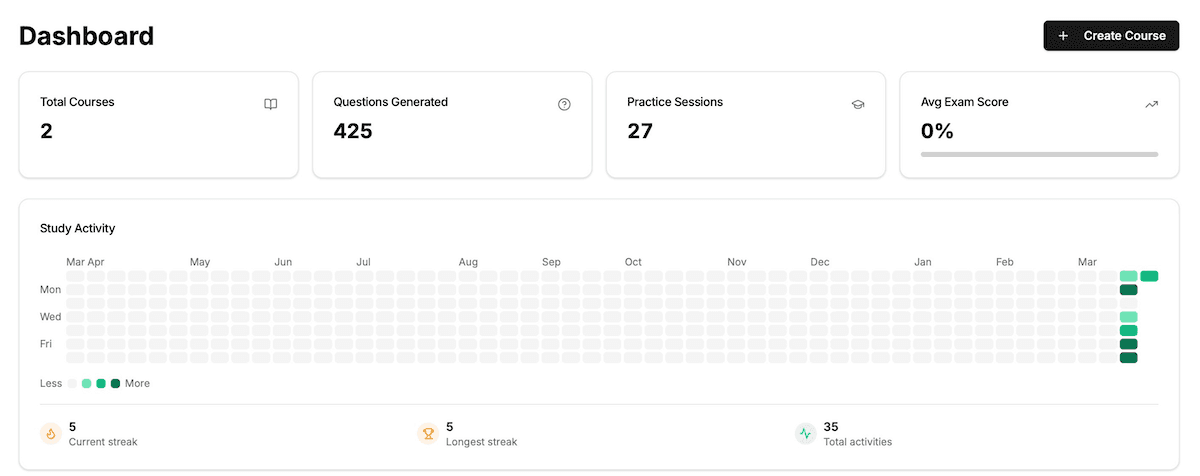
Starting today, your MoreExams dashboard has a new section: a full-year activity heatmap that shows every day you studied, practiced, or took an exam. If you've ever used GitHub, the layout will look familiar — a grid of colored squares, one for each day, where the intensity reflects how much you studied that day.
But this isn't just eye candy. It's built on a simple idea backed by learning science: the best predictor of exam success isn't how hard you study in one sitting — it's how consistently you study over time. The activity tracker makes that consistency visible at a glance.
How It Works
The heatmap covers the past 365 days. Every completed exam attempt and every practice or flashcard session counts as an activity. Days with no activity appear as empty cells. Days with activity are shaded green — the more activities you completed that day, the darker the shade.
Hover over any square to see the exact date and count. Below the grid, three stats summarize your study habits: your current streak (consecutive days with at least one activity up to today), your longest streak ever within the past year, and your total number of activities across the full window.
There's nothing to configure. The tracker pulls from your existing exam attempts and study sessions automatically. If you've been using MoreExams for a while, you'll see your full history light up the first time you load the dashboard.
Why Streaks Matter for Learning
The spacing effect is one of the most replicated findings in cognitive science. Spreading your study across multiple sessions over time produces dramatically better retention than concentrating the same total hours into fewer, longer sessions. In practical terms, studying 30 minutes a day for a week beats studying 3.5 hours in one sitting.
The problem is that spaced practice doesn't feel as productive in the moment. A long cram session gives you a sense of accomplishment. Short daily sessions can feel like you're barely making progress. That's where visual feedback helps. Seeing an unbroken chain of green squares on your dashboard reinforces that you're doing the right thing, even when it doesn't feel dramatic.
Research on habit formation tells an interesting story here. The popular "21 days to form a habit" claim is actually a myth from a 1960s self-help book. A 2009 study from University College London found that new habits take an average of 66 days to become automatic — and the range was anywhere from 18 to 254 days depending on the behavior and the person. The takeaway: consistency matters more than any magic number, and visual tracking makes that consistency visible.
People who visually track a behavior — exercise, writing, studying — are significantly more likely to maintain it. The activity heatmap turns an invisible habit into a visible one.
What Counts as an Activity
Two types of actions count toward your daily activity: completing an exam attempt (the attempt must be finished, not just started) and completing a study session in either practice mode or flashcard mode. Each individual session or attempt adds one to the count for that day.
This means a day where you ran through a flashcard deck and then took a practice exam would show as two activities. A day where you did three separate flashcard sessions across different courses would show as three. The heatmap rewards both depth and breadth of practice.
Reading Your Heatmap
The color scale has four levels. Empty cells (the base color) mean no activity that day. Light green means one activity. Medium green means two to three activities. Dark green means four or more. This scale is intentionally simple — the goal is to see patterns, not to obsess over exact numbers.
Look for the patterns that matter. Long horizontal runs of green show sustained consistency. Gaps show breaks. Clusters of dark squares might align with exam periods. Over time, the shape of your heatmap tells the story of how you study — and where there's room to improve.
Month labels along the top and day-of-week labels on the side help you orient quickly. You might notice that you tend to skip weekends, or that your activity drops off mid-semester. These patterns are hard to see without a visual tool, but obvious once they're in front of you.
Building a Study Streak
The current streak counter is deliberately prominent. It shows how many consecutive days you've studied, counting backwards from today. If you studied today, yesterday, and the day before, your current streak is 3. Miss a day and it resets to zero.
This creates a lightweight motivation loop. Once you have a streak going, you don't want to break it. A five-minute flashcard session is enough to keep the chain alive. And often, what starts as "I'll just do five minutes to keep my streak" turns into a genuine 30-minute study session once you're in the flow.
The longest streak stat gives you a personal record to beat. It's a small competitive element that only competes with yourself. If your longest streak is 14 days, the implicit challenge is to hit 15. These micro-goals add up over the course of a semester.
Try It Now
The activity tracker is live on your dashboard right now. If you're an existing user, your past activity is already mapped out. If you're new, start a practice session or flashcard review and you'll see your first green square appear.
If you're looking for a study system to pair with the tracker, start with a realistic study schedule and commit to short daily sessions using spaced repetition. The tracker turns that plan into a visual record you can actually hold yourself accountable to.
One green square at a time. That's how exams get passed.