How Our Smart Essay Grader Gives You Instant, Rubric-Based Feedback
By Per Thoresson
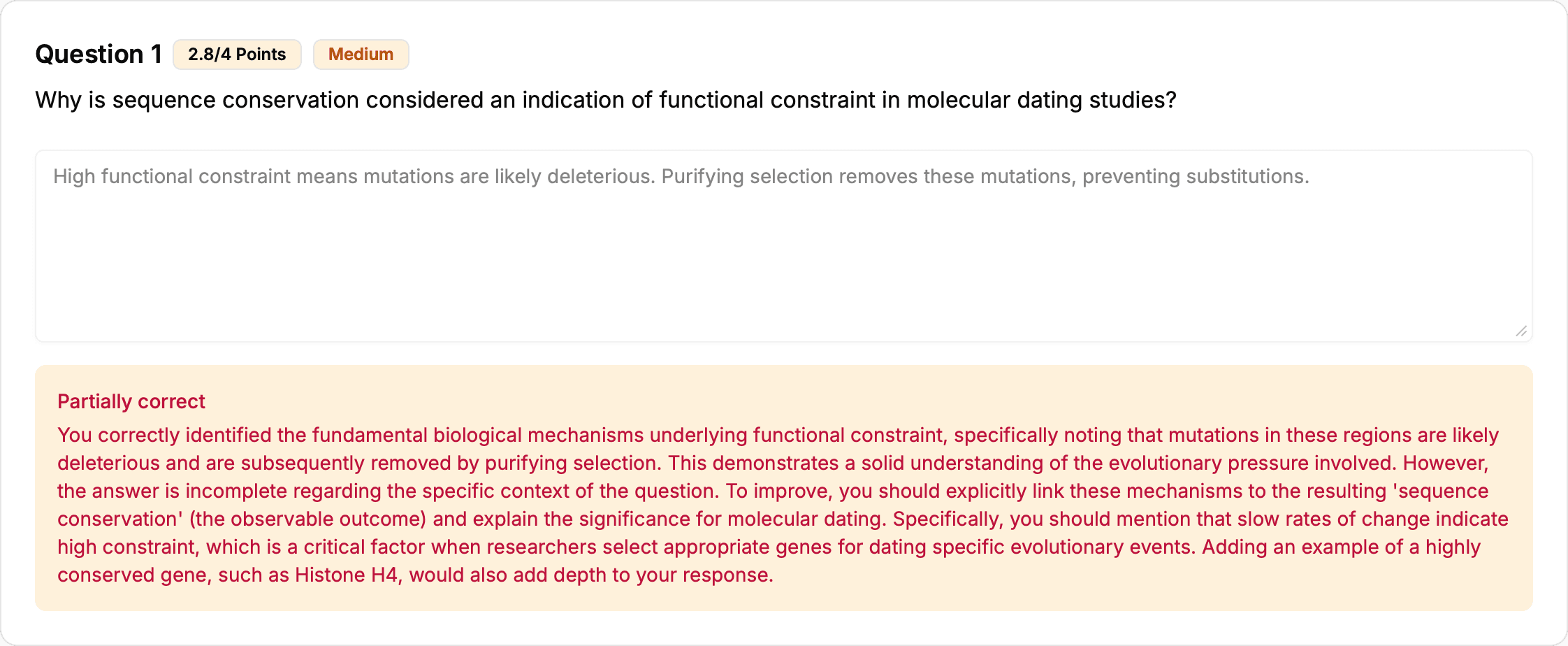
Multiple-choice questions are easy to grade. Essays are not — until now.
We built a smart essay grading system that scores open-ended answers in seconds, gives students structured feedback, and never gets tired at 2 AM.
Key Takeaways
- Scores essays 0–100 using a weighted four-criteria rubric
- Feedback is structured: what you did well, what's missing, how to improve
- Works in both practice mode and full exam submissions
- Available on Pro plan
Why Is Grading Essays So Hard?
Essay grading is hard because it's inherently subjective — two instructors can read the same paragraph and award different scores. At scale (think: 500 students submitting the same exam), manual grading becomes a bottleneck that delays feedback by days.
Delayed feedback is the enemy of learning. Students forget the context. Instructors burn out. The whole feedback loop breaks.
How Does the Smart Essay Grader Work?
The grader evaluates every essay against the course creator's own rubric - the explanation field you attach to each question. This means scores reflect your course content, not some generic writing standard.
The grader evaluates four weighted criteria:
- Accuracy & Correctness (40%) - Is the answer factually right according to the rubric?
- Completeness (30%) - Did the student address all key points?
- Clarity & Organization (20%) - Is the answer well-structured and easy to follow?
- Examples & Depth (10%) - Does the student go beyond surface-level with relevant examples?
The final score is a 0–100 integer. A score of 70 or above is considered passing. Points are then scaled to whatever the question is worth in the overall exam.
What Feedback Does a Student Actually Get?
The grader doesn't just drop a number and move on. Each graded essay comes back with three sections of structured feedback:
- What you did well - Genuine acknowledgment of correct or strong elements
- Specific gaps or errors - Precise callouts, not vague "needs improvement"
- Suggestions for improvement - Actionable next steps the student can act on immediately
This mirrors how a good professor marks a paper — except it arrives in seconds, not three weeks later.
How Is Scoring Consistency Maintained?
This is where smart graders can fall short: randomness. A model that gives wildly different scores to the same essay on different days is useless for assessment.
We address this by tuning the model to be as deterministic as possible — think of it as dialing down the "creativity" setting so the AI focuses strictly on applying the rubric rather than generating novel interpretations. The grader isn't writing poetry; it's evaluating your answer against a checklist. Consistency beats creativity here.
The model also runs a quick reasoning pass before committing to a score — similar to a TA rereading the grading criteria before marking. Something humans should do more often too.
Where Can You Use Smart Essay Grading?
In Practice Mode: Students click "Grade with Smart Grader" after writing their answer. The score and feedback appear inline, right below their response — no page reload, no waiting.
In Full Exams: When a student submits an exam that includes essay questions, the grader scores all of them in parallel alongside auto-graded questions. The review page shows per-question feedback and points earned — a complete picture of performance.
How Does Instant Feedback Improve Learning?
Research on formative assessment consistently shows that faster feedback leads to better learning outcomes. When a student writes an essay and gets feedback three weeks later, they've already forgotten the context. They can't remember why they made a particular argument or what they were confused about.
Instant feedback closes that gap. You write your answer, see exactly where you lost points, and can immediately go back to your notes to fill the gap. This tight feedback loop turns every practice exam into a genuine learning opportunity rather than just a score.
The grader scores against your rubric, not its own opinion. Students see exactly what criteria were evaluated and where they fell short. There's no black box.
One important note: for high-stakes assessment, smart grading works best as a first pass, not the final word. It's most powerful as a practice and learning tool — giving you the kind of detailed, immediate feedback that helps you improve before the real exam.
Smart essay grading works across all question types that require written responses — from short answer to full essay prompts. Upgrade to Pro to unlock it in your practice exams.